
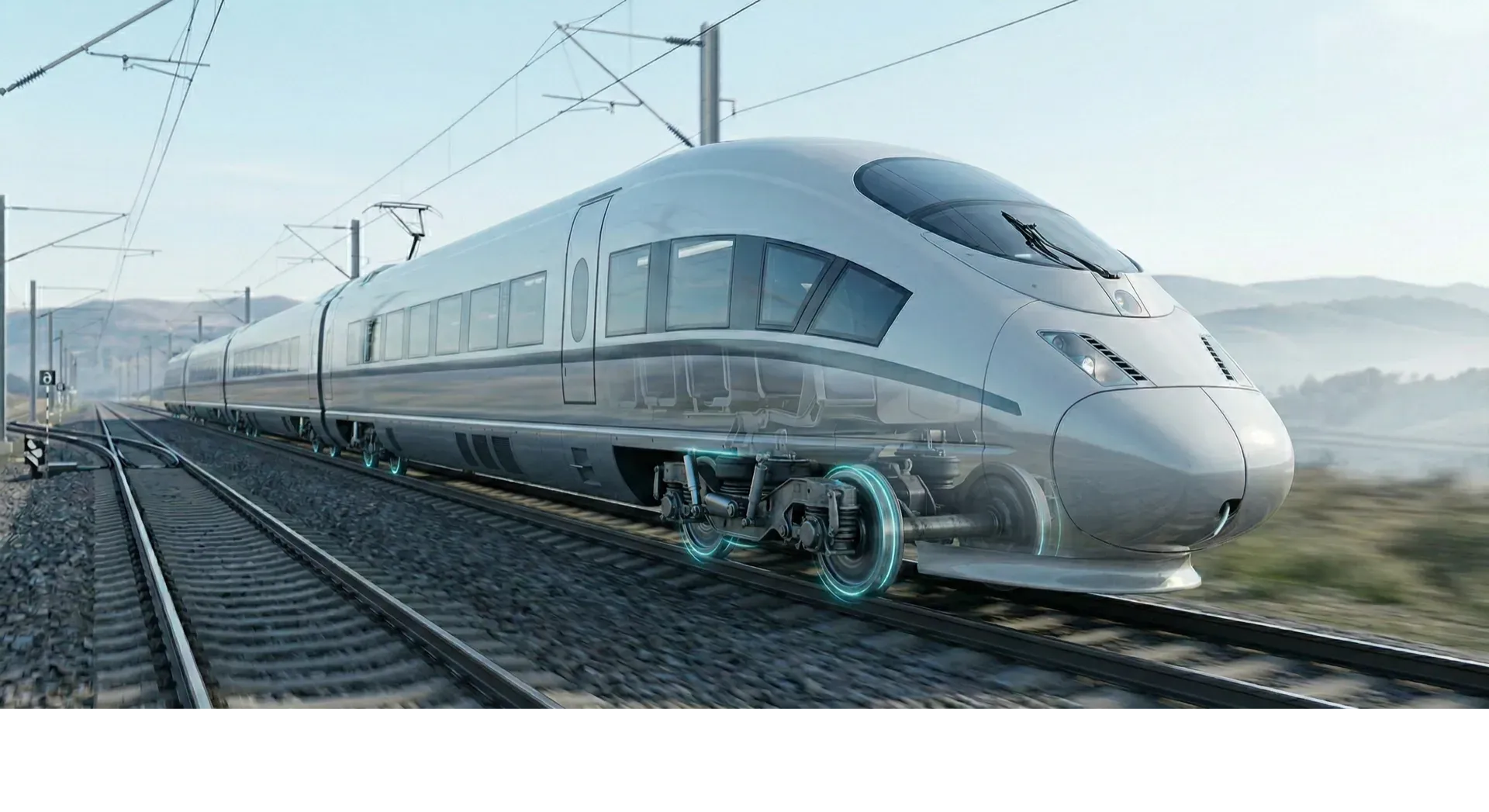
Optimizing Railway Dynamics Using Digital Twins
The interest of dynamics simulations in this sector.
Quandyga Engineering supports railway stakeholders in analyzing and optimizing the dynamic behavior of vehicles, tracks, and associated systems.
Our physics-based digital twins allow for detailed modeling of wheel-rail interactions, vehicle dynamics, and complex systems to improve performance, safety, and sustainability.
The challenges of this sector:
The railway industry imposes high demands in terms of stability, safety, comfort, and maintenance. A detailed understanding of dynamic phenomena is essential, including:
Ensuring operational safety
Controlling wheel-rail wear
Optimizing suspensions and embedded systems
Reducing maintenance costs
Facilitating certification
Maximizing the lifespan of components
Thanks to our expertise in multibody simulation with Robotran and the coupling with other physical modeling (pneumatic for suspensions, granular for ballast, electric for actuators, etc.), we develop models tailored to each project.
Our contribution in this sector:
Quandyga Engineering supports railway stakeholders in analyzing and optimizing the dynamic behavior of vehicles, machines, tracks, and associated systems.
Our physics-based digital twins allow for detailed modeling of wheel-rail interactions, vehicle dynamics, and complex systems, in order to improve performance, safety, and sustainability.
Application Areas
Railway Vehicles
- Curve stability
- Comfort and safety
- Suspension analysis (passive, pneumatic, semi-active, active)
- Study of coupling systems
Wheel-rail interaction
- Wheel-rail contact
- Contact forces and guidance
- Wear and dynamic behavior
Track and Ballast
- Detailed ballast modeling (granularity)
- Simulation of maintenance operations (track tamping)
- Heavy Traffic Route (Port Area)
Specific Machines & Systems
- Railway machines
- Pantograph kinematics and dynamics
- Dynamic embedded systems
- Hardware in the loop
Our Added Value
Technical Approach
- Physics-based multibody modeling
- Customizable models tailored to your architecture
- Coupling with other physical modeling
- Custom integration into your R&D process
Benefits
- Reduction of physical prototype iterations
- Geometric and dynamic optimization
- Improvement of safety and comfort
- Coupling with other physical models
- Support for certification processes
Simulation Examples
Discover our applied models for stability analysis, wheel-rail contact, and maintenance operations through our videos.
Vehicle entering a curve
Stability analysis of a high-speed train entering a curve. The arrows represent the wheel/rail contact forces.
Track tamping simulation
Optimization of the vibration frequency during tamping, coupled simulation between Robotran and LMGC90 during work with UCLouvain.
Wheel-rail simulation
Detailed simulation of wheel-rail contact, according to different models and under various hypotheses. Wheel and rail profiles can be easily adapted, for example based on real measurements.