
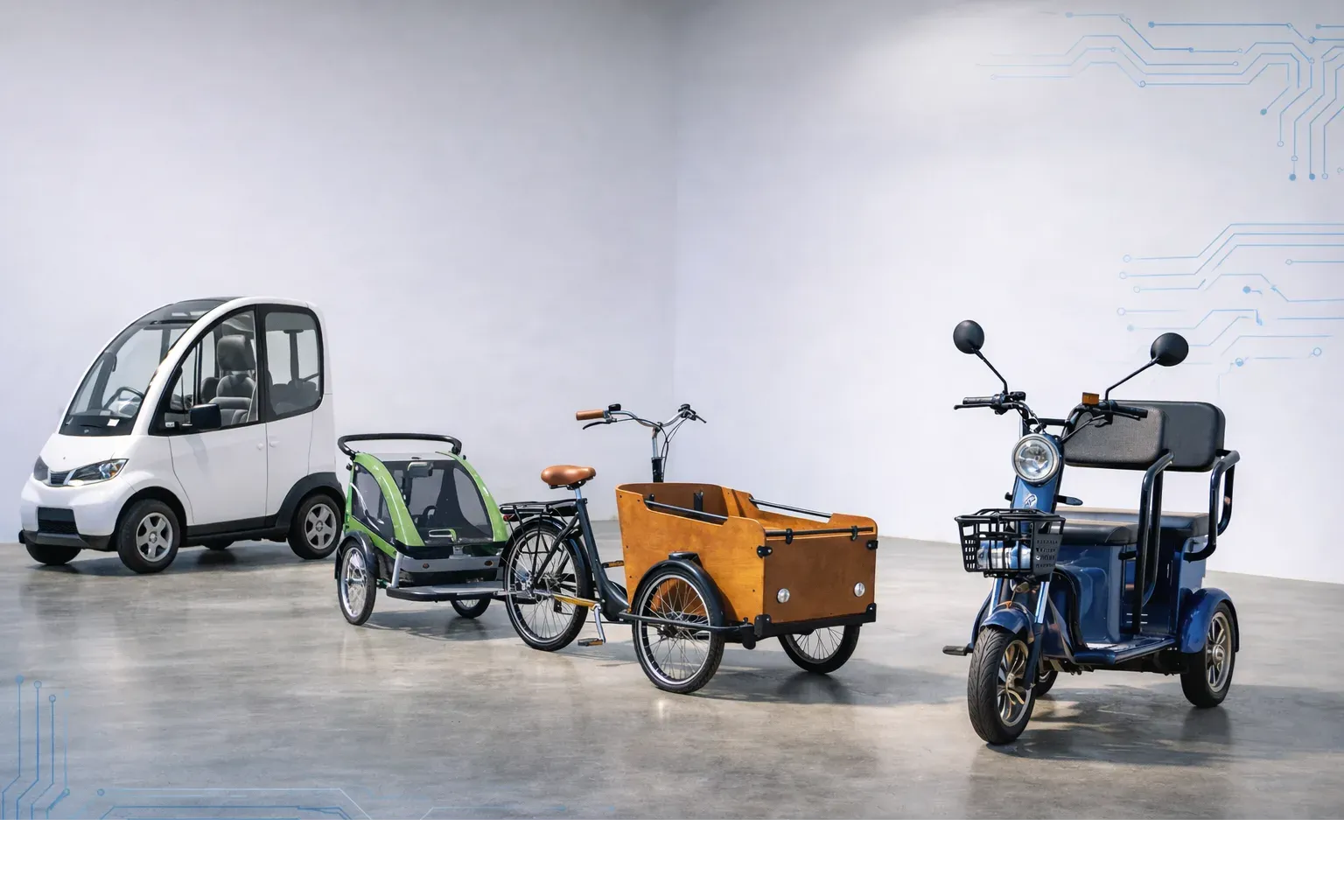
Optimizing intermediate vehicles using digital twins.
The dynamics challenges in this sector.
Quandyga Engineering provides its expertise and digital twins to address challenges related to motion dynamics. Our solutions are particularly suited for micromobility applications — bicycles, cargo bikes, trailers, light and intermediate vehicles — at various stages of development (see below). They are aimed particularly at component suppliers as well as cycle-logistics operators.
The benefits of modeling are numerous: R&D optimization, reduction of prototyping costs and resources, device configuration, and reliability improvement.
Our expertise is based on over 30 years of scientific research in numerical simulation and experimental validation
Our simulations can be complemented by experimental tests when the project requires it, comparing our models against real-world measurements. Here are some examples showing the combination of digital twin simulation with Robotran and experimental validation.
Bicycle stability as speed increases.
Trailer stability
Design of an intermediate vehicle
Dynamics of intermediate vehicles
Given the rapid development of more sustainable vehicles (cargo bikes, electrified trailers, and new architectures), a key question remains: how do they actually behave on the road?
Stability, maneuverability, energy consumption, ergonomics: dynamics directly determine safety, performance, and regulatory compliance.
Thanks to our expertise in multibody simulation and experimentally validated tools, we develop solutions tailored to each project, in order to optimize your vehicles and facilitate their preparation for certification processes.
What we provide
Benefits
- Increased safety and stability
- Improved ergonomics
- Reduced energy consumption
- Reduction of costs and design iterations
- Support towards certification
Technical approach
- Geometric optimization
- Mass distribution
- Virtual prototyping
- Control law design